A few weeks ago, I caught myself doing something I never thought I’d do.
I was treating AI like the smartest person in the room.
Not consciously.
Not because I believed it was always right. But because it was fast, confident, available, and more often than not, its answers sounded reasonable.
The problem?
Reasonable isn’t always right.
As leaders, we’re increasingly using AI to help us think, write, analyze, plan, and make decisions.
I use it myself almost every day.
But the more I use it, the more I’ve realized something important:
AI doesn’t just influence our work.
It influences our thinking.
And if we’re not careful, it can quietly reinforce biases that already exist inside us.
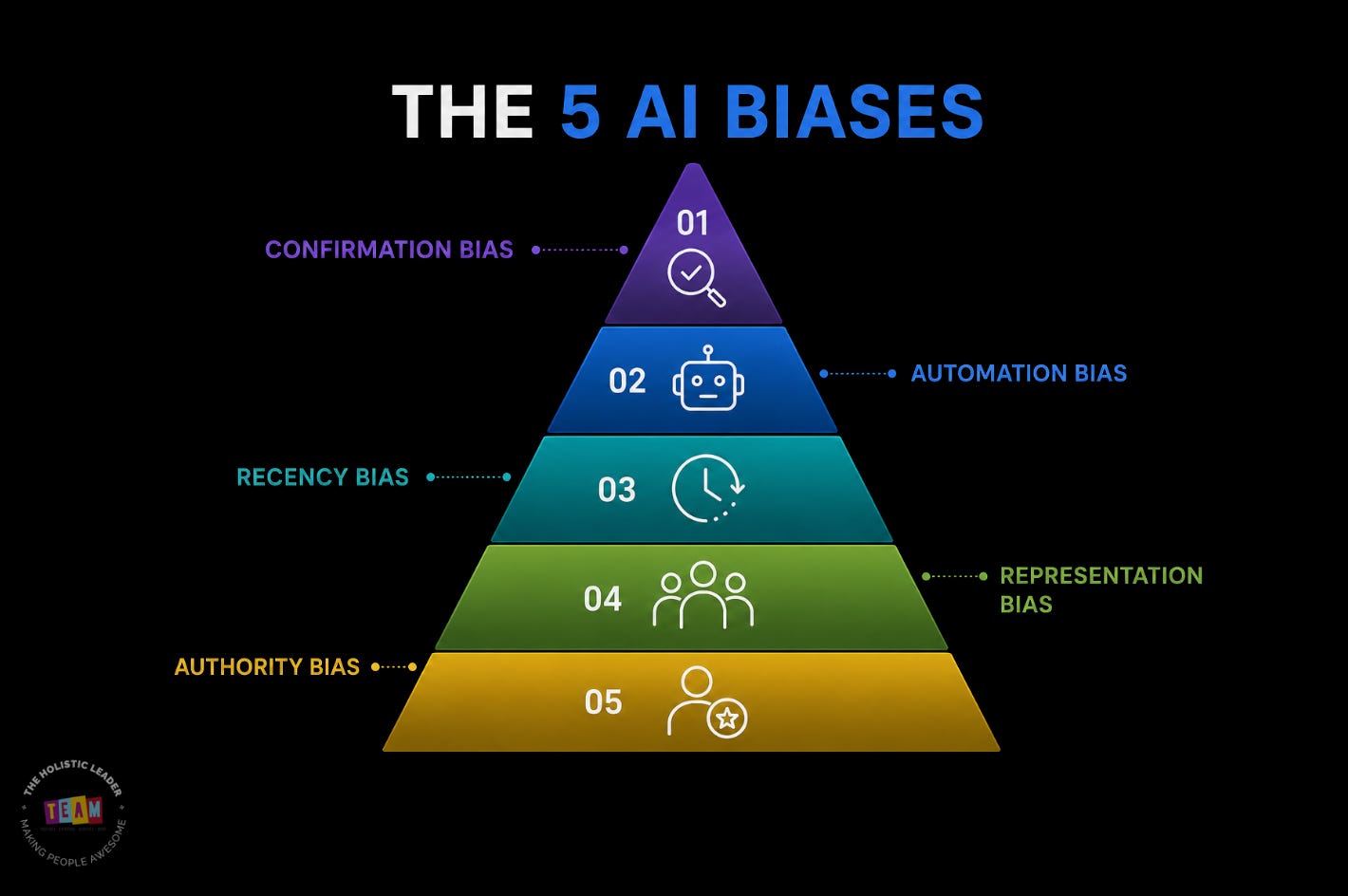
Here are five I’ve been paying close attention to.
1. Confirmation Bias
Looking for answers instead of truth
One thing I’ve noticed about AI is that it is incredibly good at helping me support an idea I already have.
If I believe something is true, I can usually find enough information to reinforce it.
And that’s where the danger begins.
As leaders, we don’t always need validation.
We need perspective.
I’ve caught myself asking questions that weren’t really questions.
They were requests for confirmation.
I wasn’t exploring, I was looking for agreement.
The challenge for me has been learning to ask:
“What am I missing?”
instead of
“Can you prove I’m right?”
The best leaders I’ve worked with weren’t attached to being right.
They were committed to getting it right.
2. Automation Bias
Trusting the tool more than my judgment
There have been moments when AI gave me an answer that sounded so polished and complete that I almost accepted it without thinking twice.
The wording was perfect.
The structure was convincing.
The logic seemed solid.
But when I dug deeper, important context was missing.
What struck me wasn’t the mistake.
It was how quickly I was willing to trust it.
Leadership requires judgment, and judgment is something we strengthen through experience, intuition, conversations, mistakes, and reflection.
I’ve learned that AI should challenge my thinking.
Not replace it.
3. Recency Bias
Confusing what’s new with what’s important
The leadership world moves fast.
The AI world moves even faster.
Every week there’s a new tool, a new prediction, a new headline telling us everything is about to change.
I’ve felt the pressure myself.
The feeling that if you’re not paying attention to the latest trend, you’re already behind.
But some of the most valuable leadership lessons I’ve learned weren’t new at all.
Trust.
Empathy.
Listening.
Clarity.
Purpose.
The fundamentals haven’t changed.
Sometimes I think leaders risk becoming so focused on the future that we forget what has always mattered.
4. Representation Bias
The voices that never make it into the data
One lesson leadership has taught me repeatedly is that numbers rarely tell the whole story.
Neither does AI.
Data can tell us what happened.
It often struggles to explain how people felt while it was happening.
Some of the most important insights I’ve gained didn’t come from reports or dashboards.
They came from conversations.
A team member speaking up.
Someone sharing a concern.
A perspective I hadn’t considered.
That’s why inclusive leadership matters more than ever.
Not because diversity is a trend.
Because different perspectives help us see what we’re missing.
And sometimes what’s missing matters most.
5. Authority Bias
Mistaking confidence for wisdom
This is the one I find most fascinating.
AI often sounds certain.
Even when it isn’t.
And if we’re honest, humans do the same thing.
I’ve sat in meetings where the most confident voice carried the most influence.
Not because it had the best idea.
Because it sounded the most convincing.
AI can create the same effect.
The response looks professional.
The language sounds authoritative.
The conclusion feels logical. So we stop questioning.
But leadership isn’t accepting answers.
It’s asking better questions.
The older I get, the more I realize wisdom often sounds less certain than expertise.
The wisest leaders I’ve met rarely rushed to conclusions.
They stayed curious.
What This Means For Holistic Leaders
I don’t believe AI is replacing leadership.
I believe it’s revealing what leadership actually is.
Because when technology can perform more tasks than ever before, the truly human qualities become more valuable.
Empathy.
Judgment.
Humility.
Curiosity.
Courage.
The ability to see people, not just data.
The ability to question assumptions, including our own.
The ability to make decisions that are not only intelligent, but wise.
That’s the challenge I’ve been reflecting on lately.
Not how to become better at using AI.
But how to become a better human while using it.
And perhaps that’s the real leadership opportunity in front of us.
I’d love to hear from you.
Which bias have you caught yourself falling into most often?
Simply hit reply and let me know, or share your questions with me.
Your insights may inspire a future edition of The Holistic Leader.
Enjoyed this article?
Share it with a leader who is navigating the opportunities and challenges of AI.
And if you’re new to The Holistic Leader, you might also enjoy: